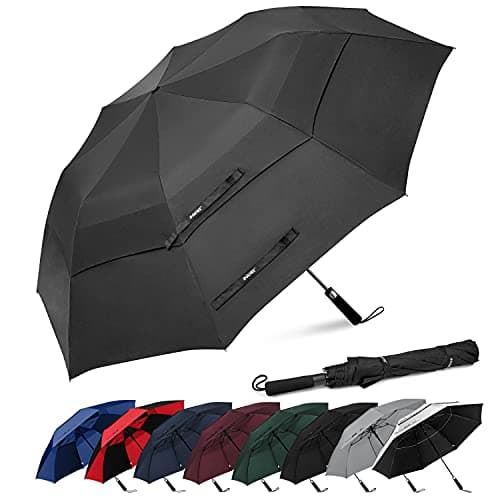
What the inches actually measure
A golf umbrella is sold on its arc: the distance across the canopy measured over the curve, not in a straight line. That is why a 68-inch umbrella does not cast a 68-inch circle of shade — the flat span is meaningfully less, which catches people out when they compare a number on a box to the gap they are trying to cover.
Golf umbrellas are oversized for a specific reason. A golfer standing on a tee is also standing next to a bag with fourteen club grips pointing at the sky, and wet grips are the actual problem — a soaked grip turns in the hand on the next swing. The umbrella is as much for the clubs as for the person.
Walk or ride, which is the real question
If they ride or push a cart, buy 68 inches. The umbrella spends most of the round mounted in the cart's holder rather than carried, so the extra size costs them nothing and covers the bag as well. Most full-size golf umbrellas are also built to fit a standard cart holder.
If they walk and carry, 62 inches. A 68-inch umbrella strapped to a carry bag is a sail: it catches wind the golfer is walking into for four miles, and it is longer than the bag, so it sticks out at both ends. This is the same arithmetic that runs gifts for golfers who walk — for a carrier, anything that adds bulk is paid for on every hole.
The double canopy, which matters more than the size
A vented double canopy is two layers of fabric with a gap between them. Wind passes up through the lower layer and out of the gap instead of building pressure under a single sheet, and the result is an umbrella that bends rather than inverts.
This is the single feature worth checking, and it is the difference between an umbrella that survives a season on an exposed course and one that is binned in March. Every pick below has it. If you are choosing between a bigger single-canopy umbrella and a smaller double, buy the double.
Length, which nobody mentions and which matters for a gift
A full-size golf umbrella is a stick around 40 to 43 inches long closed. It fits in a golf bag, a cart holder or a car boot, and it does not fit in a suitcase or a backpack. If the recipient flies to play golf, that is worth knowing before you buy one as a travel gift — it is going in the travel cover with the clubs or not at all.
Rain or sun — a real fork
In a hot, dry climate the umbrella comes out far more for shade than for rain, especially waiting on a tee box. Umbrellas built for that have a silver or reflective coating and a UPF rating, and they still keep rain off. Under grey cloud the coating does nothing, and a plain double canopy does the same rain job while looking more like golf equipment.
So match it to the weather where they play, not the weather where you are buying. And one piece of folklore worth knowing only because it comes up: some people treat umbrellas as unlucky gifts. It is nonsense, and it costs nothing to pick something else if you know the recipient believes it.
Brand, when it is the point
An umbrella is the largest, most visible thing a golfer carries, which makes the logo on it a bigger deal than the logo on anything else in the bag. A plain black commodity umbrella and a tour-branded one do the same job; the branded one reads as a gift. The caveat is that a golfer loyal to one brand from bag to ball may not want to walk under a rival's script — the golf brands worth knowing is the short version of who is who.