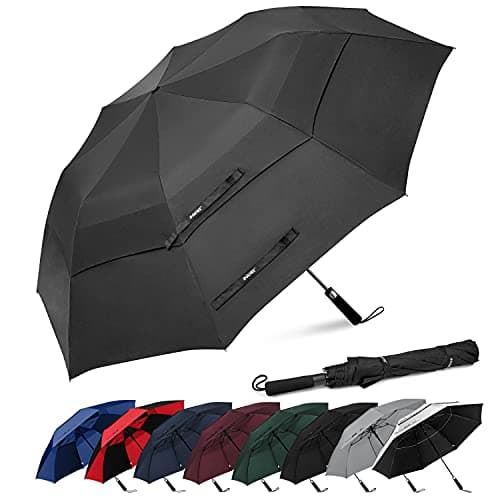
Why an umbrella is a better golf gift than it looks
Almost everything a golfer uses has a measurement attached. Clubs are fitted to height and swing speed, shoes need a size and a width, gloves need a hand. An umbrella needs none of that. There is no size to guess, no left or right, and no way for it to clash with the rest of their equipment.
It is also the kind of thing a golfer puts off replacing. An umbrella with one bent rib still technically opens, so it stays in the bag until the first real downpour proves otherwise — and that is exactly the gap a gift fills. Nobody has ever been disappointed to unwrap a good one in the week it started raining.
So the risk in this category moves somewhere else. You cannot get the size wrong. You can get the kind of umbrella wrong: a compact travel umbrella that leaves the clubs uncovered, a single canopy that turns inside out on the first exposed hole, a rain umbrella for someone who mostly needs shade. That is what the rest of this page is about.
What we looked for
We do not test golf products — our method is public — so these are judgments reasoned from what each listing publishes and from what an umbrella has to do on a golf course. Six things decide it:
- Size. A golf umbrella has to cover a person and a bag of clubs at once. Much below 60 inches it is an ordinary umbrella with a golf label on it.
- A vented double canopy. Two layers with a gap between them, so wind passes through rather than getting underneath. It is the one construction detail that decides whether an umbrella survives an open course.
- The frame.Fiberglass is the rib material golf umbrellas favor, because it flexes under load instead of bending and staying bent. Where a listing names its frame material we say so; where it doesn't, we say that too.
- How it opens. An automatic button opens it one-handed, which matters when the other hand is holding a club. Manual umbrellas are fine; they just mean putting something down first.
- A sun rating. A UPF-rated canopy turns a rain umbrella into shade, which in a hot climate is the more common job.
- An honest reason to skip it. Every pick below carries one. For umbrellas it is usually about where and how the golfer plays, not about the product.
Arc versus diameter: the number on the box
Golf umbrella sizes are usually quoted as the arc — the length measured over the top of the curved canopy, tip to tip. That is a bigger number than the diameter, which is the straight line across the open umbrella and the width that actually keeps the rain off. G4Free publishes both for its 68-inch UV model: a 68-inch arc and a 59-inch diameter, which is just under five feet across.
Arc isn't a dishonest measure — nearly every brand uses it — but most listings don't say which one they are quoting, and a few use the words loosely. So treat a two- or three-inch difference between brands as noise, and compare the size bands below rather than the exact figures.
What the sizes mean
- 60 inches is the floor. It covers one golfer and their bag if the bag stays close — Totes, whose pick sits at this size, says as much.
- 62 to 64 inches is the middle, and where the lighter and folding models live.
- 68 inches is tour size. It is what Titleist and Mizuno both sell as their Tour umbrella, and it covers the golfer and the bag without anyone having to huddle.
Bigger is not free. A larger canopy catches more wind, and a 68-inch umbrella is a lot to hold overhead for a whole round on foot. For a golfer who rides, bigger is simply better, because the cart holds it. For a golfer who walks, the middle sizes are the honest compromise.
The vent is the whole game
If you remember one thing from this page, make it this. A single-canopy umbrella is a sealed dome, and when a gust gets underneath there is nowhere for the air to go except up — which is how an umbrella turns inside out and snaps a rib. A vented double canopy puts a second, smaller layer over a gap near the top, so the air escapes through the gap instead of lifting the frame.
You can spot one from across a fairway: a vented golf umbrella has a visible step near the top, like a roof with a smaller roof on it. It is in the photo at the top of this page. Every pick below lists a vent — five call it a double or dual canopy, and Totes describes a vented canopy without saying how it is built.
That is also why we don't lean on wind ratings. Callaway and Totes both publish a 75 mph figure, and neither listing says how it was tested or against what standard. A number like that tells you the brand designed for wind; it isn't a measurement you can compare between brands. The vent is the thing you can actually check.
Does the golfer walk or ride?
This is the same two-minute test we use on the golf bags page, and it decides the umbrella as much as the bag. Look at their golf bag: fold-out legs mean they carry it and walk; no legs means it rides on a cart.
Riders barely hold the umbrella at all. It stands upright in the holder on the cart, so size and weight stop mattering and the biggest canopy on offer is the right answer. If they use a push cart, check it has a holder — our push cart guide covers which platforms take accessories.
Walkers carry it for four hours. Many golf bags have an umbrella sleeve or strap down one side, so a stick umbrella travels with the clubs, but it still has to be held up whenever it rains. For a walker, a mid-size canopy and an automatic button are worth more than the last few inches of coverage.
Rain umbrella or sun umbrella?
Where the golfer plays changes what the umbrella is for. In a wet climate it is a rain tool, and the only question is keeping them and the bag dry. In the South and the Southwest, a golf umbrella comes out far more for shade — on the tee while the group ahead plays, or on a cart path in the middle of a summer afternoon.
That is what UPF ratings are for. A UPF number describes how much ultraviolet light a fabric blocks; G4Free, Totes and Callaway all publish one for the canopies on this page, and Titleist describes a UV coating without a number. The G4Free UV pick goes further, with a silver coating on the canopy meant to reflect heat — the feature to look for if shade is the main job. Under a gray sky it adds nothing, which is why it sits last here rather than first.
Lightning: what an umbrella cannot do
This needs saying plainly. Fiberglass frames are common on golf umbrellas, and it is easy to assume a non-metal frame makes one safe in a storm. It doesn't. The National Weather Service's guidance for outdoor sports is that there is no safe place outside when a thunderstorm is in the area: stop at the first thunder or lightning, get into a substantial building or a hard-topped metal vehicle with the windows closed, and wait at least 30 minutes after the last thunder before going back out.
The NWS names rain shelters specifically as not safe, which includes the small shelters dotted around many golf courses. Give an umbrella for rain and sun. Don't give one — or describe one — as protection from lightning.
Taking a golf umbrella on a plane
The TSA allows umbrellas in both carry-on and checked bags, but it tells travelers to check with their airline for size and weight limits, and the final call at the checkpoint rests with the officer. The simple answer for a golf trip is to pack a full-length umbrella inside the golf travel bagwith the clubs, where its length isn't a problem.
The exception is the G4Free 62-inch pick, which G4Free publishes as folding down to 23 inches. That is the one umbrella on this page that goes in a suitcase.
Is an umbrella a bad-luck gift?
It comes up often enough to answer directly. In Chinese culture, giving an umbrella can be read as bad luck, because the Mandarin word for umbrella, sǎn, sounds the same as the word for breaking up. It is mostly avoided as a gift between partners, and some people avoid giving one to close family or friends for the same reason.
If the person you are buying for — or their family — would take it that way, it costs nothing to choose something else: a golf towel or a headcover does the same no-size job. If not, it is simply a useful present. We mention it because the question comes up.
What to skip
Compact umbrellas sold as "golf size." The travel-umbrella category is full of folding umbrellas with the word golf in the title. If the canopy is well under 60 inches, it keeps the golfer dry and leaves the clubs, the grips and the towel soaking. The folding G4Free here is the exception because it still opens to a full 62 inches.
Single-canopy umbrellas at any price. Covered above. Without a vent, the first real gust decides how long it lasts.
Listings that contradict themselves.We rejected one umbrella for this page because its title called it a 60-inch single canopy while its own feature list described a 64-inch double canopy. When a listing can't agree with itself, you can't know which umbrella arrives.
A name printed on the canopy. Golf umbrellas are such a common piece of logo merchandise that a name on one reads as a giveaway rather than a present. If you want a personal golf gift, the personalized page covers where a name actually belongs.
How to check without asking
Two minutes with their bag answers everything here. Look down the side of the golf bag for an umbrella sleeve or strap, and see whether there is an umbrella in it already — and what state it is in. Check whether the bag has legs, which means they walk, or not, which means they ride. If there is a push cart in the garage, look for a holder on the handle.
If you can't get at any of that, the safe purchase is a 64- to 68-inch vented double canopy from a brand they already carry. It cannot be the wrong size, and it will be used the first day it rains. For more gifts that work without a measurement, see golf gifts that need no size.