Check they walk before you buy anything
This is the disqualifier for the whole category and it takes one question. Some golfers walk every round; some take a motorized cart every round; many are somewhere in between, depending on the course and the weather.
A push cart is a superb gift for the first group and a bulky, unwanted object for the second. If you can't ask directly, the tell is the golf bag itself: a stand bag with fold-out legs belongs to a walker. A big cart bag with no legs belongs to someone who rides.
Three wheels or four
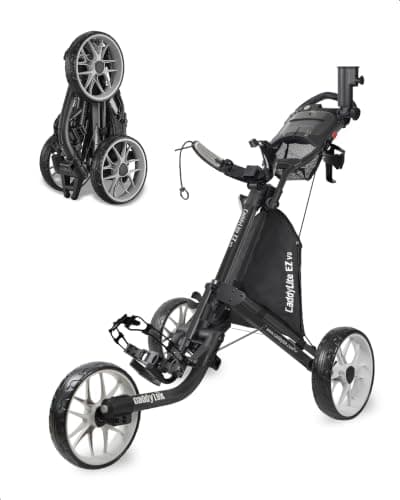
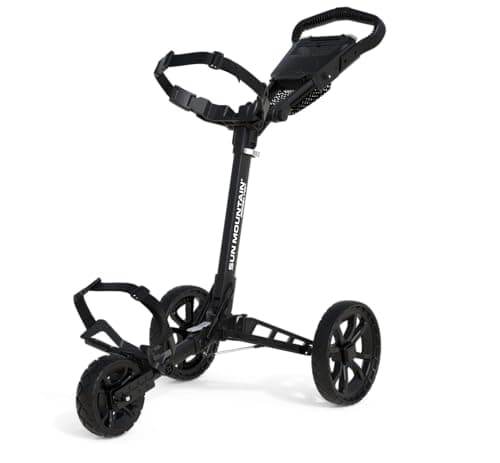
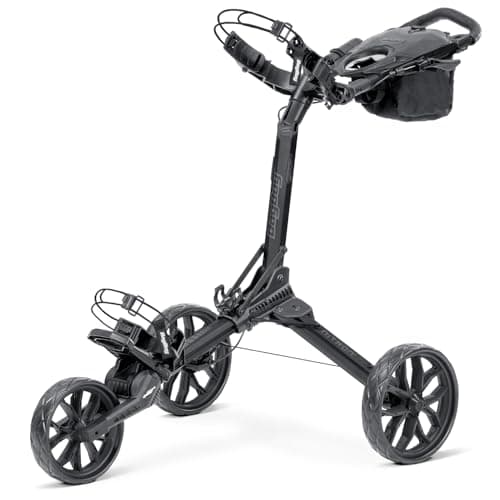
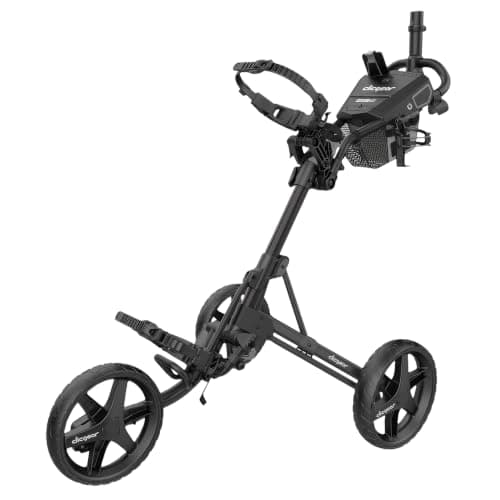
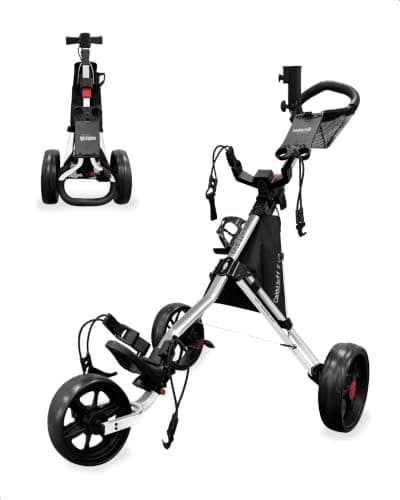
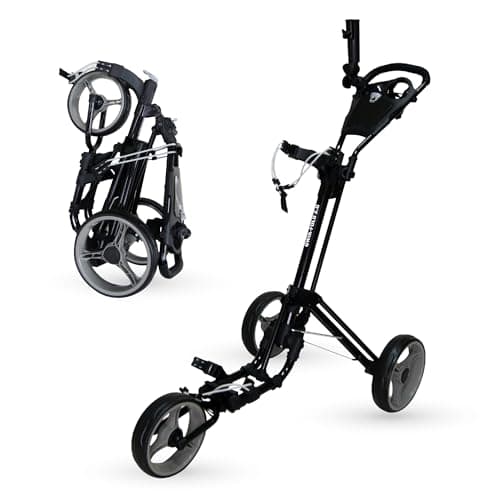
Three-wheel carts are the default and the majority of the market. They steer easily, they are generally lighter, and the front wheel swivels or locks depending on the model.
Four-wheel carts are more stable on a slope and track straighter on a traverse, and they tend to fold smaller because the frame geometry allows it. They are also usually a little heavier for equivalent build. Neither is wrong. Unless the person you are buying for plays somewhere notably hilly, a three-wheel cart is the safer gift.
The fold is what people actually complain about
Every push cart rolls fine. What separates them in daily use is the thirty seconds at each end of the round, in a car park, usually in a hurry and sometimes in the rain.
A good cart opens in one motion and collapses in one or two. A bad one has a sequence you have to remember, catches your fingers, and needs a knee to hold it while you work a latch. Bag Boy's nitrogen-assisted system takes this to its conclusion — release the latch and it opens itself — and that matters most to precisely the golfers who benefit most from a cart in the first place.
Weight is the second thing, and it is about the car
The published weight of a push cart has almost nothing to do with pushing it. Fifteen pounds and twenty-five pounds feel identical rolling across a fairway.
Where it matters is lifting the folded cart into a car boot, twice a round, forever. For a golfer in their seventies, or anyone with a back that complains, the difference between an eighteen-pound cart and a twenty-five-pound one is real and repeated. That is the argument for the lightweight models, and it is the reason weight appears in the specs at all.
What the price buys
Around $100 gets a functional three-wheel cart that folds and holds a bag. It is a genuine gift and its weak point is the folding mechanism over years of use.
Between $150 and $270 is the sweet spot: better bearings, a fold designed rather than improvised, a usable storage console, and a brake that works. Most golfers should be given a cart from this band.
Above $300 you are buying either assisted opening or the accessory ecosystem — the Clicgear platform in particular has golf umbrella holders, coolers, seats and brackets built for it, which turns the cart into something the owner keeps customizing. That is a real benefit to a keen walker and an irrelevance to everyone else.
Push cart or electric trolley?
Electric trolleys — motorized, remote-controlled, several times the price — are a different category and a different budget. They are wonderful and they are also a thousand-dollar decision with battery maintenance attached, which makes them a poor surprise gift.
A push cart is the right present because it removes the load without introducing anything to charge, service or regret. If they later want an electric one, they will buy it themselves. We cover the case for walking with a cart at all in are golf push carts worth it.
If the cart is one part of a present for someone who walks every round, the rest of that list — the lighter bag, the towel they can actually reach, the things that do not add weight — is on gifts for golfers who walk.