Why a rangefinder is hard to hold still
A laser rangefinder is a small monocular. You look through it, put a reticle on the flagstick and press a button, and the beam has to be on the flag at the moment you press. At 150 yards a flagstick fills very little of that view, and the magnification that makes it big enough to see also magnifies every tremor in your hands.
That is the mechanism, and it explains why the problem gets worse rather than better with a more expensive unit: higher magnification is sold as a premium feature and it makes the shake more visible, not less. It also explains the two symptoms golfers describe - either the number never appears, because the beam keeps sliding off the flag onto the trees behind it, or a number appears and it is the distance to the trees.
This affects far more golfers than the category admits: anyone with an essential tremor, anyone on medication that causes one, anyone with arthritis in the hands, and in a milder form almost every golfer in cold weather or after a long round.
What actually helps, in order
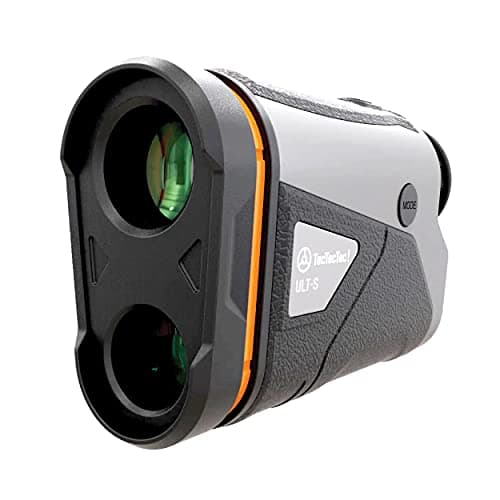
Image stabilization. The real fix, and the hard one to shop for because only some makers publish it. A stabilized unit smooths the view optically or electronically, so the reticle stays roughly where you put it. TecTecTec publishes stabilization on the ULT-S, which is unusual at that end of the market and is the main reason it is on this page. Where a maker does not state it, assume it is absent.
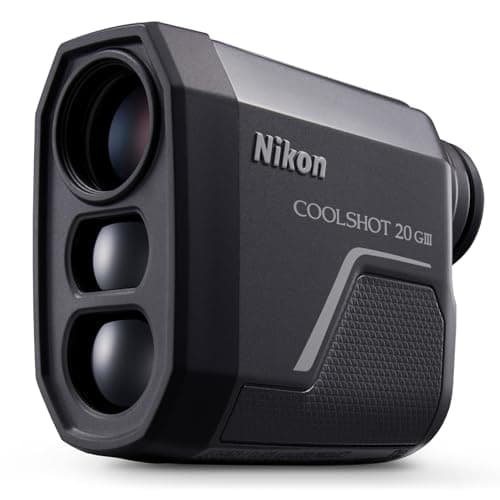
Lower magnification. Counter-intuitive and genuinely useful. 6x is easier to hold on a flag than 7x, because the shake is magnified by the same factor as the image. Nikon publishes 6x on the Coolshot 20 GIII along with the bright glass its optics business is built on, and bright plus steady is a better combination here than distant and jumpy.
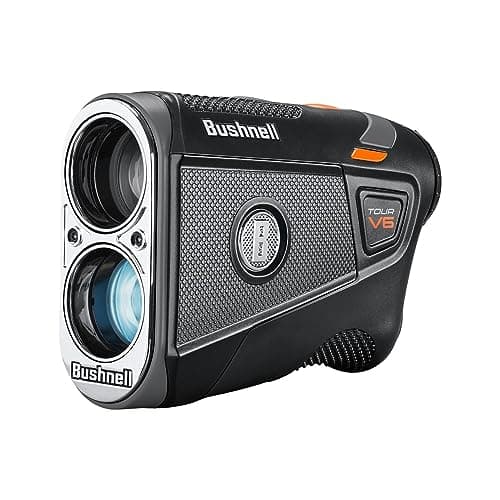
Lock confirmation. If you cannot hold the reticle still, you need the device to tell you it got the flag rather than asking you to judge it. Bushnell publishes visual lock confirmation on the Tour V6; other makers use a vibration pulse. Either is better than nothing, and a pulse you feel is better than a symbol you have to see, because seeing it requires the steadiness you do not have.
Something to brace against. Free, and nobody mentions it. Resting the rangefinder on the top of a golf bag, a cart rail, or against the shaft of a club held upright turns a handheld measurement into a supported one. This helps more than any feature on this list.
What does not help
Maximum range. The headline number on every box - 800, 1000, 1300 yards - is the least relevant spec in the category for anybody, and completely irrelevant here. No golf shot is 1000 yards.
Slope. A genuinely useful feature, and nothing to do with this problem. It adjusts for elevation after the measurement, so it does not make the measurement easier to take. Note that slope-adjusted distances are not permitted in competition, which is why a physical switch matters - slope versus non-slope has the detail.
A bigger, heavier unit.Plausible reasoning - more mass damps a tremor - and it does not survive contact with a golf course, because the weight has to be held at arm's length with one hand. Heavier units are harder, not easier.
The honest answer: often a GPS watch instead
We have no interest in selling the harder product. If the shake is pronounced enough that aiming is genuinely a struggle, a laser rangefinder is the wrong tool and a GPS watch is the right one.
A golf GPS watch gives distances to the front, middle and back of the green with no aiming at all - it knows where the green is and where the wearer is standing, and it shows the number on a wrist. The trade is real and worth stating: a watch cannot measure the distance to a tree, a bunker lip or anything else that is not in its course map, where a laser can measure to anything you can point it at. For a golfer who wants a number for their approach shot, that trade costs almost nothing.
It is also usually cheaper. The simplest golf watches cost less than a mid-range rangefinder. GPS watch versus rangefinder is the full comparison, and best golf watches is the category.
If you are buying this as a gift
Two things to check. First, whether they already own a rangefinder - they last for years and a duplicate at this price is awkward to return quietly. Look for a small rectangular pouch clipped to the outside of their bag.
Second, do not ask them whether their hands shake. Watch instead: someone who uses two hands on a phone camera, who braces a coffee cup, or who has mentioned a tremor to anybody is telling you. Buying the stabilized or lower-magnification option costs nothing extra and is never the wrong choice even if the shake is mild. The three picks below are, in order, the one that publishes stabilization, the one with 6x and the brightest glass, and the premium unit with visual lock confirmation.