Where fourteen comes from
Fourteen is the limit the Rules of Golf set on how many clubs a player may carry in a round. It is a maximum, written to stop a tour player carrying a club for every conceivable distance, and it has become the number everyone assumes a golf bag is supposed to contain.
Nothing requires a golfer to carry fourteen, and plenty of good players carry fewer. For a beginner the limit is irrelevant: the constraint is not the rules, it is that a bag of fourteen clubs is heavy and that choosing between two clubs whose distances they cannot yet tell apart is a decision with no information in it.
The seven that matter, and what each one is for
- A driver. The longest club, used off the tee. It is also the hardest to hit, and many beginners are better off starting with the fairway wood until the driver behaves.
- A fairway wood or a hybrid. For long shots from the grass. A hybrid is easier to hit than a long iron, which is exactly why hybrids exist.
- Three or four irons, spread out — something like a 6, 8 and pitching wedge. Consecutive irons go distances a beginner cannot yet tell apart, so skipping numbers gives real gaps rather than imaginary precision.
- A wedge. For short shots and getting out of bunkers, which is where new golfers lose most of their shots.
- A putter. Roughly 40 per cent of the shots in a round, and the one club nobody argues about needing.
That is a complete golfer. Everything beyond it narrows the gaps between distances, which only helps once someone can hit a given club the same distance twice.
Why a lighter bag is a real argument, not a soft one
A golf course is about four miles of walking, and a full bag weighs twenty-five to thirty-five pounds. Seven clubs instead of fourteen is several pounds off a beginner's shoulder for that whole distance, and a new golfer who finishes a round tired plays the back nine badly and enjoys it less. If the person you are buying for intends to walk, this matters more than club selection does — gifts for golfers who walk is built on the same arithmetic.
What this means when you are buying a boxed set
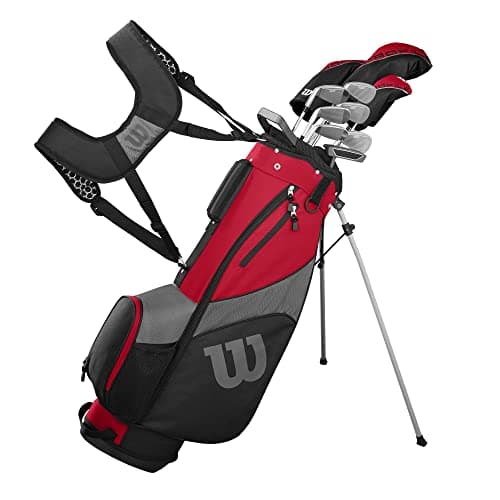
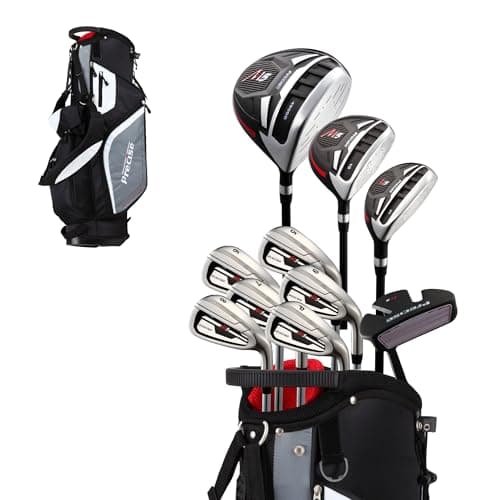
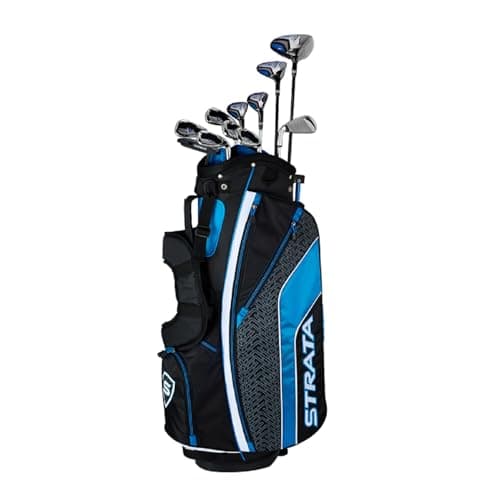
Beginner sets are sold on piece count, and the counts are inflated in a specific way: a headcover is a piece, and so is the bag. A "16-piece" set is not sixteen clubs. So when you compare two sets, count the clubs rather than the pieces.
More usefully, the extra clubs in the bigger sets are not the forgiving ones. What makes a club easy for a beginner to hit is a large, high-forgiveness head, and every set in this category has that on the irons. The step up in price buys more clubs, a better bag and a nicer finish — not a better strike. Which is why we would spend the difference on lessons and buy the mid-priced set.
The one thing you cannot compromise on is handedness and length. Every boxed set is listed per hand, and most lines sell regular, long and senior lengths as separate listings. The wrong one is unusable rather than imperfect, and that is the single most expensive mistake in this category. All three sets below are the right-handed regular-length listings.
If they are buying for a child rather than an adult
Different answer entirely, because junior clubs are fitted to height. Four or five clubs is plenty, and the fit matters far more than the count — best junior golf clubs goes through the height bands.