Check handedness before anything else
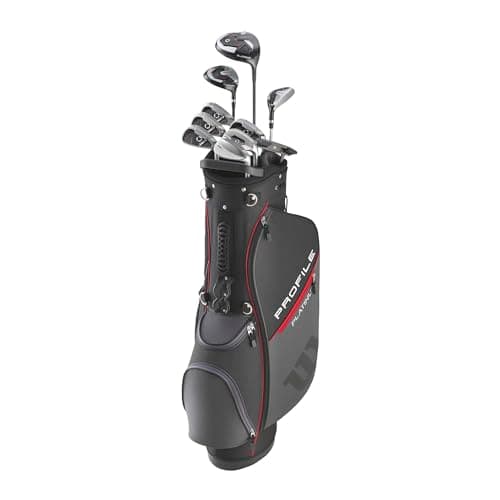
This is the mistake that turns a $450 present into a return, and it is invisible on the listing page unless you look for it. A complete set is sold as a separate product for each hand. The Wilson Profile SGI right-handed listing and the left-handed listing are different ASINs with different pages.
Roughly one golfer in ten plays left-handed, so the odds are with you — but the consequence of being wrong is total. A left-handed golfer cannot use right-handed clubs at all. If you can, watch them mime a swing: their lowerhand on the grip is the hand that matches the set. If you can't ask and can't watch, this is the one case where a gift receipt genuinely solves the problem.
Then check height, which decides the length
Sets are also sold in length variants — usually described as regular, tall or petite, and sometimes as a senior flex. Shaft length is set by the player's height, and it matters most at the extremes: someone at 6ft 3in playing regular-length clubs stoops over every shot, and someone at 5ft 2in playing the same clubs is fighting a club that is too long to control.
Between roughly 5ft 6in and 6ft 1in, the standard regular listing is the right call and you do not need to think about it further. Outside that range, spend two minutes finding the tall or petite version of the same set.
Why a boxed set beats buying clubs individually
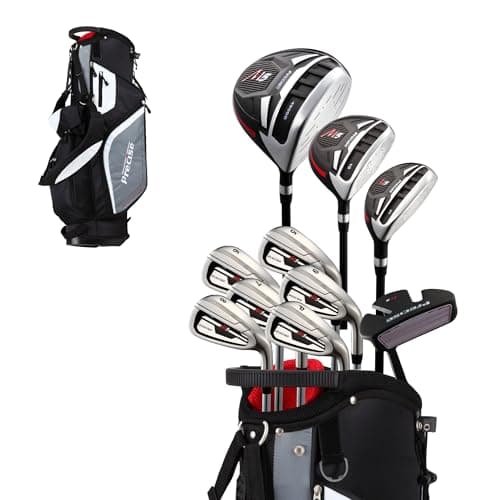
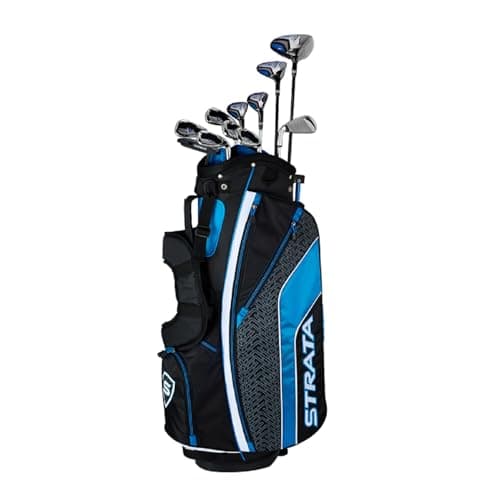
A new golfer needs a driver, at least one fairway wood, a hybrid, five or six irons, a wedge, a putter and a bag. Bought separately and new, that is well over a thousand dollars. Bought as a package set, it is three to six hundred.
The clubs in a package set are genuinely more forgiving than better clubs, too, which is not a consolation prize. Manufacturers build them with oversized heads and a low center of gravity specifically so mishits still get airborne — which is exactly what a beginner needs and exactly what a set of tour irons refuses to do.
What the price tiers actually buy
Under $200 you are buying an eight-piece set from a brand that exists only on the marketplace. It works, but it leaves gaps in the middle of the bag and it is the one thing a beginner will notice on a first tee.
Between $300 and $500 is where the sensible gifts are: twelve to fourteen pieces from Wilson, Precise or Strata, with a bag that is not an afterthought. Above $600 you are buying club count and finish, not forgiveness. A sixteen-piece Strata is a more impressive box to unwrap, and it does not make the ball go further than the fourteen-piece.
Women's sets are not men's clubs in a different color
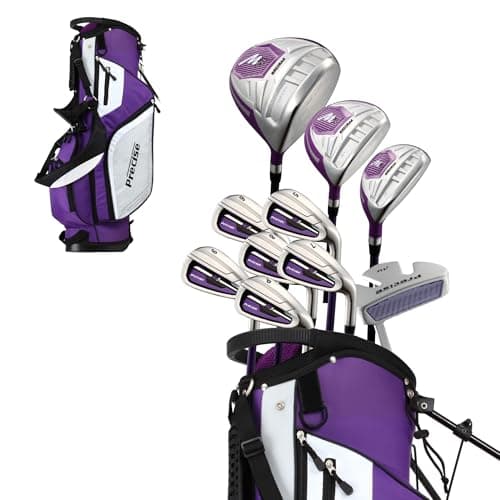
They are shorter and lighter, with a more flexible shaft, and both differences are real engineering rather than marketing. A woman of average height playing men's regular-length clubs is playing something about an inch too long with a shaft too stiff for her swing speed — and she will assume the resulting bad shots are her fault.
If you are buying for a woman starting golf, buy a women's set. The same tiers apply, and the same variant warnings: petite, regular and tall are separate listings.
What the set does not include
Balls, tees, a glove and shoes. None of them come in the box, and all of them are needed on day one. Adding a dozen soft golf balls and a glove to the set costs about forty dollars and turns a big present into a complete one — and unlike the clubs, a glove and a box of balls carry no variant risk beyond which hand the glove goes on.
When not to buy a set at all
If they already own clubs, do not. Someone with a half-set they inherited does not want a package set; they want the specific thing that is missing, and that is usually a rangefinder, shoes or a bag. If they have taken lessons and are talking about a fitting, also do not — a fitted set is a personal decision with measurements attached, and a package set arriving in the middle of that conversation is awkward.
And if the beginner is a child rather than an adult, this is the wrong page: junior clubs are fitted to height and a scaled-down adult set is not the same thing. Best junior golf clubs covers the height bands, and how many clubs a beginner needs explains why the piece count on the box is not the number to compare.
One exception worth naming: if they already own a bag of clubs and the driver is the hand-me-down that never goes straight, a set is the wrong purchase and a single club is the right one. Best golf drivers for beginners covers that case, including the three facts - hand, flex and loft - you have to confirm before buying any club on its own.