Why one towel is not enough
A golf towel has two incompatible jobs. Cleaning a club face means getting dried mud out of narrow grooves, and that needs water - a dry cloth just smears it. Drying hands and grips means removing water, which a damp cloth obviously cannot do.
Golfers who carry one towel end up compromising on both: a slightly damp towel that cleans badly and dries worse. The fix costs almost nothing, which is why this is one of the few golf questions with a clean answer. Carry two, keep one damp, keep one dry, and know which is which without looking.
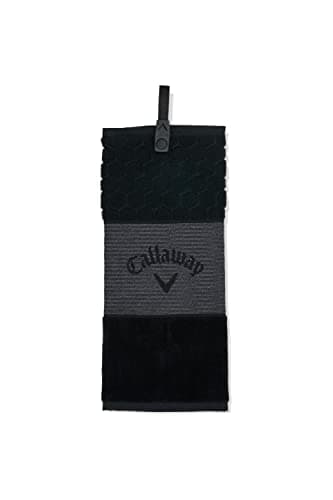
The tri-fold design exists to solve this on a single towel. Three panels folded over a bag rail means you can soak one end at the water cooler and leave the other two dry, and plenty of golfers run that setup plus one spare rather than two separate towels.
Wet towel, dry towel - what each is actually for
- The damp one. Club faces after every shot, grooves, the sole of a wedge after a bunker, and the ball when the rules allow lifting it. This towel gets filthy and is the one that goes in the wash after every round.
- The dry one. Hands between shots, the grip in humidity, sweat, and the inside of a glove if the weather turns. Grips get slippery from skin oil and water rather than from dirt, and a dry towel is the whole solution for a round.
The practical reason this matters more than it sounds: a wet grip is the most common cause of a club turning in the hands at impact, and it is completely preventable. Golfers who sweat heavily usually get there by a different route and buy a glove for it, but the towel is the cheaper first step.
Where the towel hangs, which decides whether it gets used
This is the part that actually determines whether a towel is any good, and it has nothing to do with the fabric.
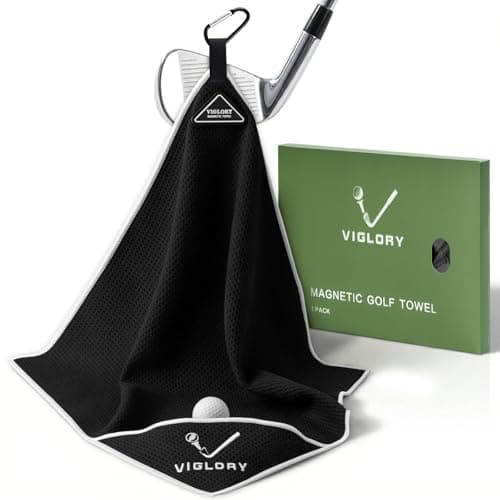
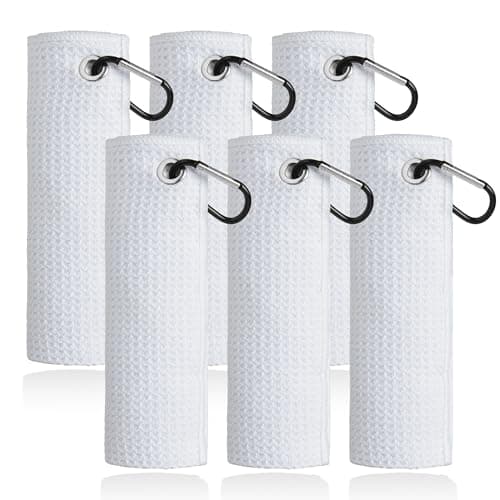
A towel with a grommet and a carabiner clips to a bag ring. That is the standard and it works, with one flaw: on a cart, the bag is behind the seat and the towel is three steps away at the moment it is wanted. A magnetic towel sticks to the steel frame of a cart or to a club shaft, which puts it where the golfer is standing. For a golfer who rides, that is the difference between a towel that gets used every shot and one that gets used on the green.
For a golfer who walks and carries, the carabiner version is better - there is no cart to stick anything to, and a magnet adds weight for nothing. Gifts for golfers who walk runs that argument across the whole category.
What makes one towel better than another
- Microfiber beats cotton for club cleaning, because it holds more water for its weight and gets into grooves. Waffle-weave microfiber is the common premium version and the texture is doing real work rather than being decorative.
- Size, roughly 16 by 21 inches or larger. Small towels fold into something the size of a face cloth and run out of clean surface by the ninth hole.
- A clip or a magnet that is actually attached to the towel, rather than a loose carabiner threaded through a grommet that will tear. This is where cheap towels fail first.
- Color, which is not a style question. A white towel looks superb for one round. Everything on a golf course is mud-colored for a reason.
So how many should you buy as a gift?
A multi-pack, almost always. Towels are the most straightforwardly consumable durable item in golf: they get filthy, they get left on carts, they go through the wash constantly, and no golfer has ever been annoyed to receive more of them. That makes them one of the very few golf gifts where a duplicate is a feature.
The sensible gift version is one good magnetic or tri-fold towel plus a cheap multi-pack behind it - the good one lives on the bag, the pack lives in the car and the garage. At under twenty-five dollars for both, it is also one of the better-value things on the under-$25 page.
One pairing worth knowing: a towel and a club brush together make a complete cleaning kit for about thirty dollars, and the method takes ten seconds a shot. That combination is a noticeably better gift than either half.