How this page is filtered
Every bag below qualified for the under-$100 band on a price we fetched from the Amazon product API, not one we typed into a template. A bag with no verified price does not appear here at all, and one that moves above $100 drops off rather than sitting under a heading it cannot afford. The figure beside each pick is a separate, request-time read carrying its own checked date.
That matters here because this band sits right on a cliff. Several of these bags live in the nineties, and golf bags discount and recover by colorway, so a page with hand-typed prices would be listing bags above its own cap within a fortnight. It is also why none of the bags already on our stand bag page appears on this one: the cheapest of those sits above the cap, so every pick here is a product the site did not carry before.
At this price you are buying a carry bag — that is the first fact
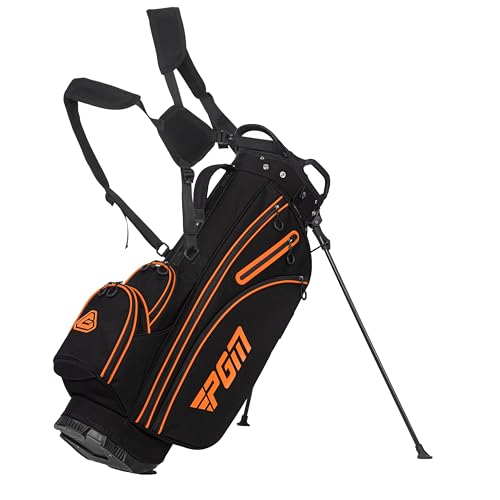
Golf bags come in two shapes. A cart bag is big and heavy with no legs, built to sit strapped to a riding cart. A stand bag has two fold-out legs and two shoulder straps and is built to be carried.
Under $100 the honest answer is that you are buying a stand bag, every time. Cart bags exist at this price and they are a bad version of the thing: a cart bag is mostly structure and hardware, and that is exactly what gets cut first. So if the recipient rides a cart every round, this is the wrong page — the stand versus cart comparison covers how to tell, and the tell is fold-out legs in any photo of them with their clubs.
The real decision: how many clubs does it need to hold?
This is the question that sorts the page, and it is not about money.
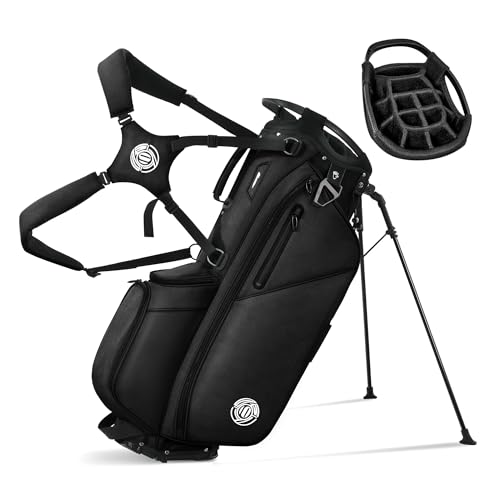
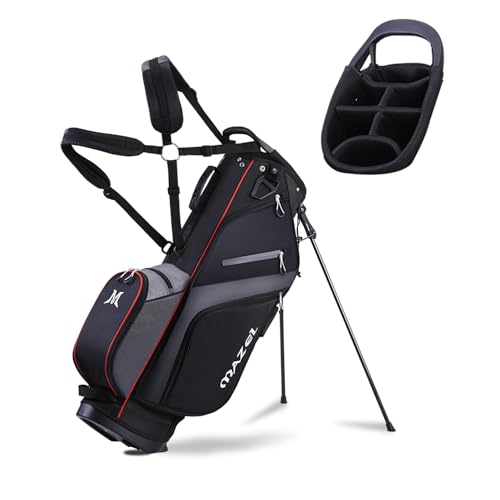
A full set. Fourteen clubs, every round, on a real course. Buy a full-size stand bag — the top pick, the 14-way, or the six-way light one. All three take a complete set; they differ in how much they separate the clubs and how much they weigh.
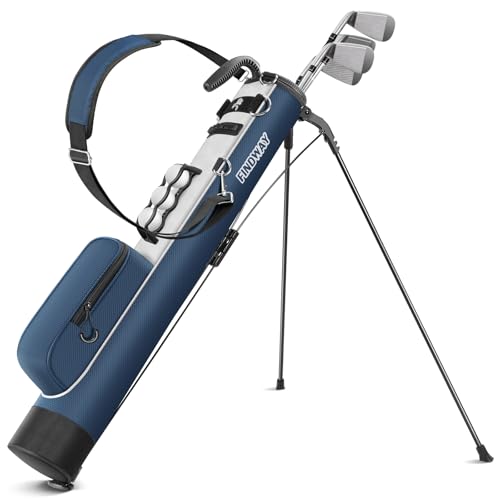
Half a set, for the range or a short course. Buy the small bag. A golfer going to the driving range to hit a bucket with three clubs does not want to carry fourteen, and the honest truth is that a cheap small bag gets used far more often than a cheap big one. It is also the right first bag for somebody who is not yet sure golf will stick.
You genuinely do not know. Buy a full-size one. A big bag can carry a small set; a small bag cannot carry a big one.
Dividers and weight are the same trade
Carry-bag listings advertise divider count — four-way, six-way, fourteen-way — and gift buyers read a bigger number as better. On a bag that gets carried, it is a trade rather than an upgrade.
Every full-length divider is another tube of fabric and plastic running the length of the bag, so fourteen ways is heavier than six, and weight is the thing that matters on something spending four hours and five miles on somebody's back. Fourteen ways means nothing clatters and nothing tangles. Six ways means clubs share slots, which costs a little noise and saves real weight.
Which to pick: if they have ever complained about clubs clattering, buy the 14-way; if they walk a lot and never mention it, buy the light one. Our divider explainer goes further, and the short version is that the answer flips depending on whether the bag is carried or wheeled.
One spec to actually check on the listing: a double strap. A single strap hangs the bag off one shoulder, which is fine across a car park and miserable across a course. Every full-size pick here states one.
What $100 does not buy, stated plainly
A brand they recognize. This is the honest limit of the band. The established golf names — the ones on the bags at their club — start above it, and the bags here are Amazon-native brands or value lines. For a golfer who has opinions about equipment, the logo is part of the gift, and no feature list fixes that. If that is your recipient, the answer is a real stand bag above this band or a different present entirely.
Hardware that survives hard use. Zips, strap anchors and leg mechanisms are where a cheap bag gives ground, and they give it fastest on a bag loaded and soaked several times a week. For a golfer who plays monthly this is irrelevant; for one who plays three times a week it is the whole difference.
A warranty you would rely on. Buy at this price for a casual golfer, a beginner, a second bag or a range bag — not as the bag somebody will own for a decade.
Choosing by what the golfer does
They walk and carry a full set. The top pick. Full capacity, double strap, and the cooler pocket is genuinely used by a walker who has nowhere else cold to put a drink.
Clubs clattering drives them mad. The 14-way. It is the heaviest bag here and that is the price of the dividers.
They count ounces. The six-way. Fewer dividers, less fabric, less weight.
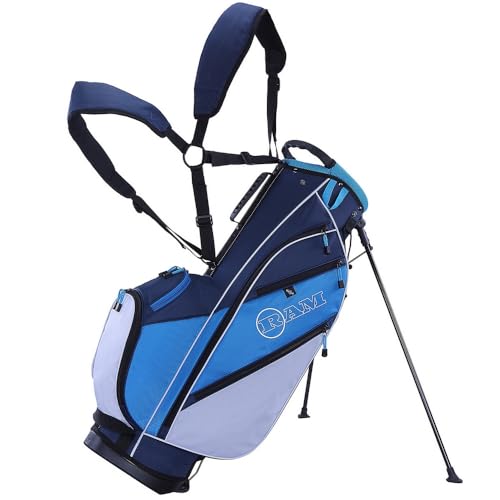
You are buying for a woman golfer.The Ram ladies bag is the one here listed and finished as its own product rather than a men's bag in a different color, and it sits at half the band. If she would rather have capacity than styling, the top pick is unisex.
They already own a bag they like. Buy the small one as an addition, not a replacement. Replacing a bag somebody chose themselves is the risk our main bag page warns about; adding a range bag carries none of it.
They push a trolley. A carry bag works on a push cart, but if the trolley is the real gap, a push cart solves more at a similar price than a second bag does.
What we are not recommending
A cheap cart bag. A cart bag at this price cuts the structure and hardware that make a cart bag worth having. If they ride, spend above the band.
A bag with no stand legs that is not a small bag. A full-size bag that cannot stand up has to be laid on wet grass at every shot.
A bag as a surprise upgrade for a golfer with a good one. A bag is visible, personal and chosen. Under $100 it will not beat what a keen golfer already owns, and a worse bag is not a gift.
Counterfeit branded bags. A famous golf brand at $60 is not that brand. Everything on this page is a value-brand listing sold at this price on purpose.
If the budget can stretch, the next band up changes the category rather than merely improving it. Golf bags under $200 is where TaylorMade, Cleveland and Sun Mountain appear, where cart bags become worth owning at all, and where the hardware that gives way first on a cheap bag stops giving way.