Why the answer is a range and not a number
"Golf simulator" is used for four genuinely different products, and the reason the internet gives you a figure spanning two orders of magnitude is that it is answering four questions at once. Before any price makes sense, you have to know which of these you are actually shopping for.
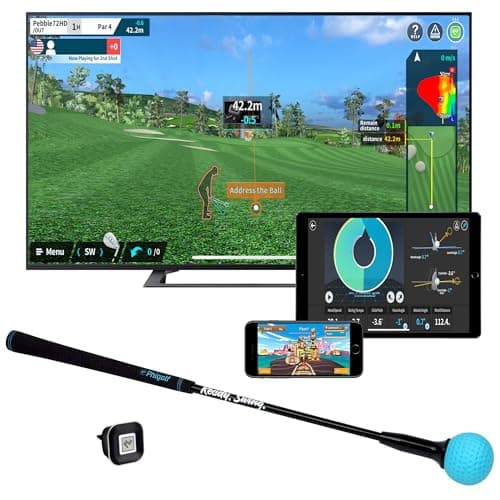
Tier one: a swing sensor, no ball
The cheapest thing sold as a home simulator is a motion sensor that clips to a short training club. You swing, the sensor reads the motion, and a phone, tablet or TV plays the shot on a virtual course. No ball is struck, so nothing flies anywhere.
That limitation is also the feature. It needs a living room rather than a garage, it cannot break a window, and it genuinely entertains a golfer in January. What it cannot do is tell anyone anything true about how far they hit a 7-iron, because it never measured a golf shot. As a gift it is excellent and as a practice tool it is close to useless, and the listings are not always clear about which of those they are selling.
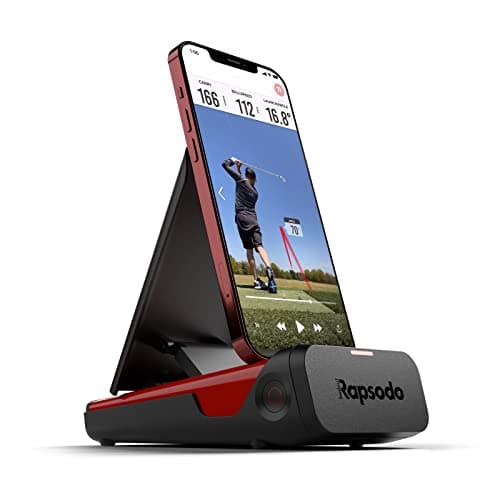
Tier two: a mobile launch monitor
The first tier that measures a real golf shot. A small radar unit sits behind the ball, you hit an actual ball into a net or down a range, and it reports carry distance, ball speed and club speed to a phone.
This is the sweet spot for most people, with one catch worth knowing before you buy: the cheapest of these are iOS-only, so an Android household should check the listing rather than assume. The numbers are real but the feature set is narrow - carry, ball speed, club speed, and not much else. For a golfer who wants to know whether their new driver actually goes further, that is already enough.
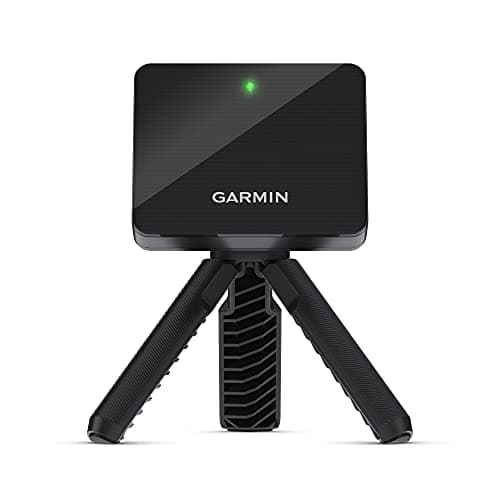
Tier three: portable radar with a simulator mode
The mainstream answer and the one we would point most buyers at. A portable radar launch monitor works at the driving range outdoors and into a net at home, and adds a home-simulator mode that puts the shot on a virtual course rather than just reporting a number.
This tier is where a device stops being a toy or an instrument and starts being both. It is also where the hidden costs start to bite, because to use the simulator half indoors you need the net, the mat and the ceiling - see below.
Tier four: photometric cameras, and the ceiling problem
The top tier most home buyers reach is a photometric unit: instead of tracking the ball down-range with radar, it photographs the ball in the first few inches of flight and calculates the rest.
That difference is not a spec-sheet detail, it is the whole reason this tier exists. Radar needs to watch the ball travel, which means it needs distance behind and in front of the hitter and a decent amount of height. A camera unit only needs to see launch, so it works in a garage with a ceiling that would make a radar unit unusable. If the room is the constraint - and in most houses the room is the constraint - this tier is not a luxury, it is the only thing that works.
The costs nobody quotes
This is the part that turns a device price into a project budget, and it is the reason home simulator builds routinely cost twice what the buyer expected.
- Something to hit into. A net is the cheap version and an impact screen with a projector is the expensive one. Neither is included with any launch monitor. Our training aids page covers nets, and a basic net-and-mat combination is a real gift on its own.
- A hitting mat. Hitting off a thin mat on a concrete floor is how golfers acquire wrist injuries. A proper mat with some give under it is not optional for indoor use, and the cheap ones are the ones to avoid.
- Ceiling height. The single most common reason a home setup fails. A full swing with a driver needs roughly ten feet, and that is before the net. Measure first. If the answer is eight feet, you are in the photometric tier or you are hitting irons only.
- Space behind and in front. Radar units state a required distance behind the ball and in front of it. A garage that is long enough for a car is not automatically long enough for radar.
- A subscription. Several of these devices put the courses, the shot library or the practice modes behind an annual fee. The device price and the useful price are not always the same number, and this is the one to read the listing for.
- A laptop or tablet, and a projector. Only if you are going to a screen rather than a net. This is the cost that pushes a build into a different category entirely.
What to buy at each budget, honestly
If the recipient has a living room and curiosity, buy the swing sensor and do not pretend it is more than it is. If they have a garden and want real numbers, buy the mobile launch monitor and a net. If they are serious, have measured their ceiling and it clears ten feet, the portable radar unit is the best value in the category. And if the ceiling is low, skip straight to photometric or spend the money somewhere else entirely - a rangefinder or a golf watch gives a golfer something they will use every round rather than something that does not fit the house.
The full category, ranked rather than priced, is on best home golf simulators, and the three picks below are one from each of the first three tiers with today's live price on each.