How this page is filtered
Every cart below qualified for the under-$200 band on a price we fetched from the Amazon product API, never one typed into a template. A cart with no verified price does not appear, and one that moves above $200 drops off rather than being listed under a heading it does not fit. The number beside each pick is a separate request-time read with its own checked date.
The cap is doing real editorial work here. The full push cart category runs past $340, and the premium end sells on fold mechanisms and brand rather than on anything that changes a round of golf. Capping at $200 removes the three most expensive carts on the site and keeps every cart that does the job.
What a push cart actually fixes
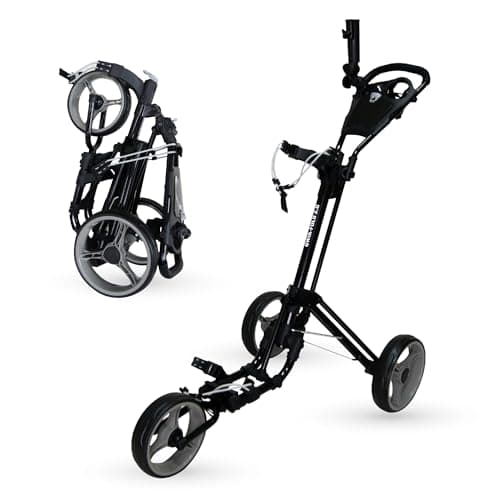
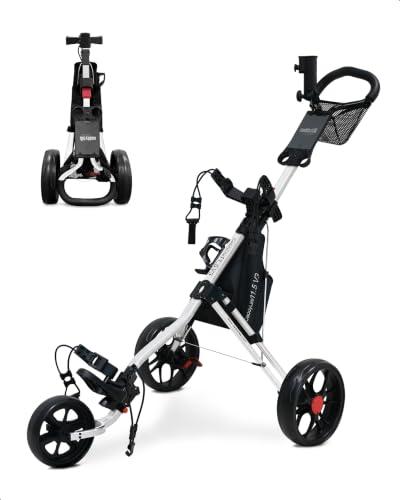
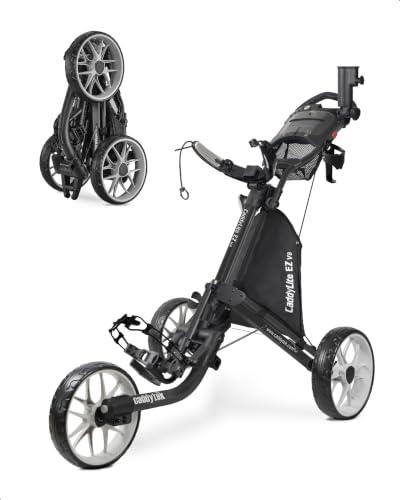
A push cart is a three-wheeled frame the golf bag straps into, which the golfer pushes round the course instead of carrying the bag on their back. That is it. No motor, no battery, no remote control.
The problem it solves is specific and physical. A full set of clubs in a bag is twenty to thirty pounds, and a round of golf is four to five miles over uneven ground. Carrying that on one or two shoulders for four hours is the part of golf that stops being fun first — not the walking, the carrying. A push cart removes the weight from the body while keeping the walk, which is the part most golfers actually want.
That makes it one of the highest-value gifts on this site for one particular golfer: the one who walks, loves walking, and has started mentioning a shoulder, a back or a knee. Nothing else in golf gear changes their experience of a round as much for the money. It is also the gift that keeps a golfer playing for several more years than they otherwise would, which is why it appears on our page for older golfers and the page for golfers who walk.
Three wheels, and why not two
All three picks here are three-wheel carts and that is deliberate. A three-wheel cart tracks straight with one hand on the handle, which matters because a golfer pushing a cart is also carrying a drink, reading a yardage or talking to somebody. A two-wheel cart has to be pulled and leans, which is harder work across a slope and the reason the design has largely disappeared.
The exception is storage: two-wheel carts fold smaller and weigh less. If the trunk is genuinely tiny, that is the trade — but check the folded dimensions of the three-wheel carts first, because at this price they fold remarkably small.
The fold is the whole product
This is the thing gift buyers underrate and owners care about most. A push cart lives in a car trunk and gets folded and unfolded twice every round, in a parking lot, often in the rain, usually while holding something else.
A one-motion fold — pull one lever, the frame collapses — is the difference between a cart that gets taken to every round and a cart that gets left behind on a day when the golfer is in a hurry. Every pick here publishes a quick-fold mechanism of some kind; the top pick is the one whose fold is a single click.
Then measure the trunk. The folded dimensions are on every listing, and the car is the real constraint rather than the course. A cart that fits only when the clubs come out of the trunk is a cart that stays in the garage. This is the one number to check before ordering, and it is the only way this gift fails outright.
The features worth having, and the ones that are decoration
A storage basket or console is worth having. It holds a drink, a phone, a glove and a sandwich, and it is the reason a cart golfer stops carrying things in their pockets. All three picks have one.
A foot brake matters on any course with slopes, which is most courses. A loaded cart rolls away on a gradient, and the brake is what stops a golfer chasing their clubs down a hill.
An umbrella holder is a small, genuinely useful bracket that keeps a golf umbrella over the bag rather than in a hand. On a wet-weather course it is the difference between dry grips and wet ones.
Hand brakes, seats and electric conversions are where the money goes above this band. A seat sounds appealing and is rarely used; golf has a pace-of-play convention that discourages sitting down between shots.
What a push cart is not
It is not an electric trolley, which has a motor and a battery, costs several times as much, and is a genuinely different product. It is not a riding cart, which is the thing with a steering wheel that the course rents out. Listings use all three words loosely and a gift buyer should not.
It also does not work with every bag. A cart bag with no stand legs is the ideal partner, and our cart bag page covers that pairing; a stand bag works fine too, with its legs folded. What does not work well is a very large staff bag on a light cart.
Who should not get one
A golfer who rides a cart every round. They have solved this problem already, and the money belongs on a cooler or a cart speaker.
A golfer who carries by choice and is proud of it. Some golfers walk with a light carry bag deliberately, and a cart reads as a comment on their fitness rather than a kindness. Buy them a better stand bag.
A golfer at a club that restricts trolleys in winter or on certain courses. Rare, but worth a thought if you know the club.