What a hitting mat is, and why it is the half of the gift people forget
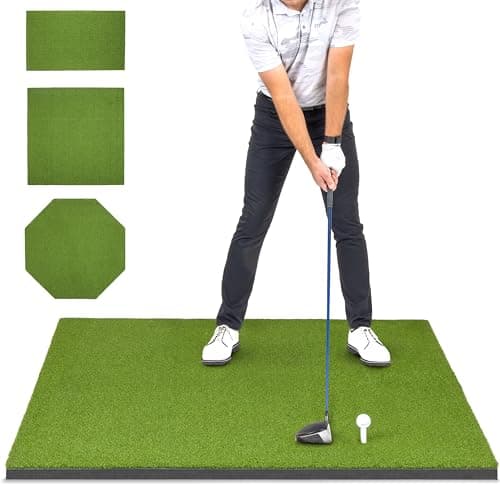
A hitting mat is a slab of artificial turf on a cushioned base. The golfer stands on it, puts a ball on it and hits full shots off it, usually into a net in a garage or a garden. It is the floor of a home practice setup.
It is also the part that gets skipped, and the reason that matters is physical rather than aesthetic. A golf club does not sweep the ball off the ground — it descends into it, and on a real course the clubhead carries on into the turf and takes a divot out of it. On a lawn that means a hole in the lawn every single shot. On a concrete garage floor, or on a thin doormat laid over concrete, the clubhead meets something that does not give at all and the entire shock of the impact travels back up the shaft into a wrist, an elbow and a shoulder. Golfers do this for a fortnight, get sore, and stop practicing.
So the mat is not an accessory to the net. It is the thing that makes the net usable more than twice, which is why it sits on this site as its own page rather than as a footnote on the practice net roundup.
The one spec that sorts this category: base thickness
Hitting mats are sold on pictures of turf, and turf is the least important part. Every mat in every listing photograph looks like a rectangle of green grass. The difference between a mat that protects a joint and one that does not is underneath the turf.
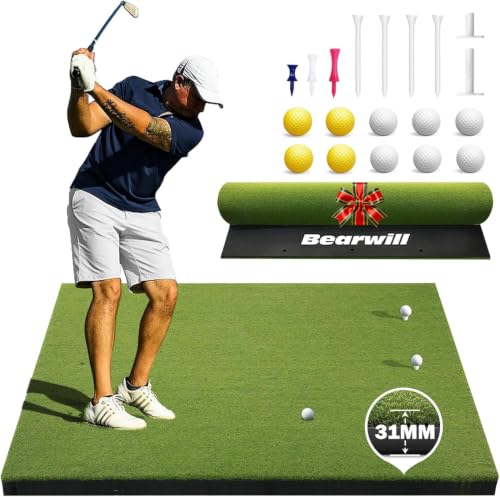
Look for the millimeter figure. Listings state a build thickness — 5 mm, 15 mm, 26 mm, 31 mm, sometimes a range because the seller offers several versions. That number is the depth of the cushioning layer plus the turf pile. More of it means the clubhead travels further into the surface before it is stopped, which is exactly what happens on real grass, and the energy that would have gone into a wrist goes into the foam instead.
The material matters nearly as much. The better mats name EVA foam, the dense closed-cell foam used in running-shoe midsoles. It compresses under load and comes back. A cheap rubber-backed mat is a thin sheet of rubber: it stops the club dead.
What the thin ones are actually for. A 5 mm mat is not a scam, it is a different product. It is a wear surface for a floor that is already soft — a lawn, a thick carpet, a gym mat — or a chipping surface where the club barely touches the ground. Two of the picks below are thin on purpose and say so.
Measure the room before you order, because this is the gift that comes back
A full-size hitting mat is 5 by 4 feet, or 5 by 5 feet for the square ones, and it is dense enough that a single person has to drag rather than carry it. It does not fold. A 31 mm mat rolled up is a cylinder nearly a foot across. There is no cupboard it goes in.
That makes the available space a hard filter, and it comes before price and before brand:
A garage bay, a shed or a basement. Buy any of the full-size mats. Note that the swing also needs ceiling height — a driver needs roughly nine to ten feet of clearance, which the home simulator page goes into because it is the constraint that kills most garage setups.
A patio or a lawn, mat carried out and back. Buy a full-size mat only if there is somewhere dry to keep it between sessions. Artificial turf on a wet base left out all winter is a mat that grows things.
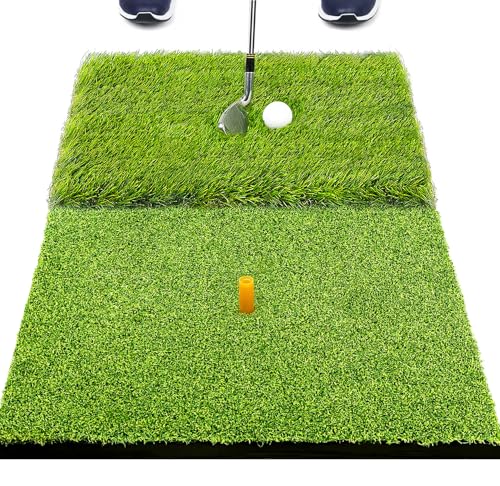
A spare room or an apartment. Buy the foldable mat and do not pretend otherwise. Full shots are not happening in that space anyway — the swing arc of a seven iron is wider than most hallways — so what is realistic is chipping and short wedge shots, and a small two-surface mat is the correct tool for exactly that.
Does the net already include a mat?
Check this before anything else if the recipient already practices at home, because it is the most common way this gift turns into a duplicate. Several practice nets ship with a thin mat in the box, and the site's own net page carries one of them. Those included mats are usually in the 5 to 10 mm class — fine as a wear surface on grass, not enough on concrete.
So there are two honest situations. If they have no net and no mat, a mat alone is an odd gift and a net-plus-mat bundle is the better buy. If they have a net and a thin mat and they practice on a hard floor, a proper thick mat is one of the best upgrades available to them and they will notice it on the first swing.
Turf height, tee holes and the small things that decide whether it gets used
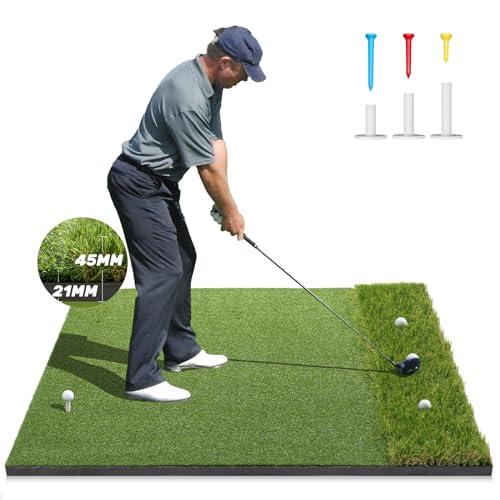
Rubber tee holes. You cannot push a wooden tee into a mat. Mats take rubber tees that sit in a punched hole, and most of the picks below state that tees are included. If a mat has no hole, the golfer can only hit shots off the deck, which rules out the driver.
One surface or two. A single-surface mat is a fairway lie, every time — ball sitting up on short grass. That is the easiest shot in golf and the one amateurs least need to practice. A dual-turf mat adds a longer, rougher surface so the golfer can rehearse the shot where the ball is sitting down, which is most of the shots in a real round.
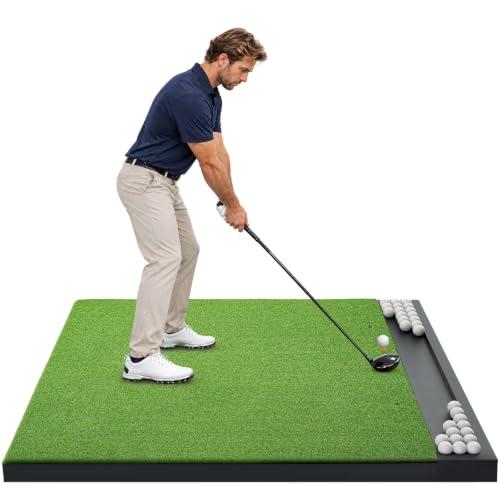
A ball tray. Trivial-sounding and the difference between a ten-minute session and a forty-minute one. Without somewhere to keep the balls at hand, every shot involves bending down, and sessions end early.
Size behind the ball. A mat you hit off but cannot stand on changes the swing, because the feet are on a different level from the ball. Any mat under about four feet in its shorter dimension is a hitting surface rather than a stance, and that is a real limitation rather than a quibble.
How we ranked these
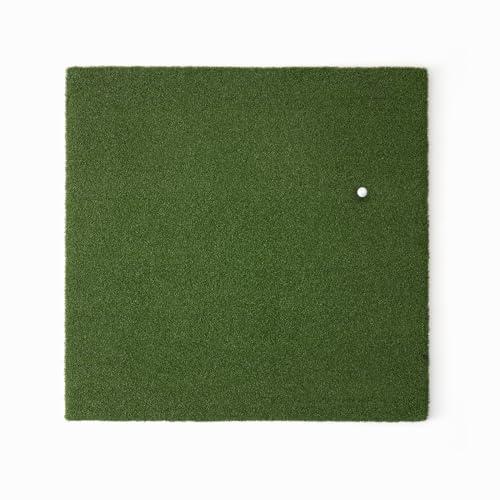
In order: base thickness first, because that is the one that protects a body; then whether you can stand on it; then what the extra surfaces and trays add; then price. Brand is deliberately last on this page, with one exception — the SkyTrak mat is here because its square footprint and its name matter if a launch monitor is already in the room, which is the situation our launch monitor roundup covers.
Every score on this page is a judgment reasoned from the published listing, never a measurement — we have no lab and how we pick says so in those words. Where a listing gives a figure we quote the figure and attribute it. Where it does not, we say that too: the SkyTrak listing describes feel and stability and never states a thickness, so we do not invent one for it.