The gift nobody asks for and everybody uses
Go and look in the garage of someone who plays golf. The bag will be leaning in a corner at about fifteen degrees off vertical, resting on the concrete, with the driver headcover touching the floor and a wedge sticking out at knee height. Behind it there will be a cardboard box that cannot be reached. Every few weeks the whole thing falls over when a car door opens, and somebody props it back up.
That is the normal condition of golf clubs in an American garage, and it persists for a simple reason: a leaning bag is not quite a problem. It is an irritation that resets itself. Nobody stands in a pro shop deciding between a new wedge and a storage rack, because the rack is not the thing they came in thinking about. It is only ever bought by somebody else.
Which is exactly what makes it a gift. It needs no size, no hand, no handicap and no brand loyalty. It cannot be wrong for their swing. It is impossible to duplicate by accident, because if they already had one you would have seen it. And it fixes something they look at every single week. That combination is rare - it is the same argument as a trunk organizer, applied to the other place golf clubs live.
What the leaning bag actually costs
Two things, and one of them is not obvious.
The obvious one is the bag. Sun Mountain, who build golf bags, publish care guidance that says to store a bag in a cool, dry place, that proper storage "prevents material breakdown and reduces exposure to humidity," and that "moisture can lead to mold, mildew, and unpleasant odors if not addressed quickly." A bag standing in contact with a concrete slab is the opposite of that on both counts: concrete holds and transmits damp, and a bag resting against a wall has one whole face with no air moving across it. That is the mechanism behind the complaint every golfer eventually has about an old bag, which is that it smells and they cannot work out why.
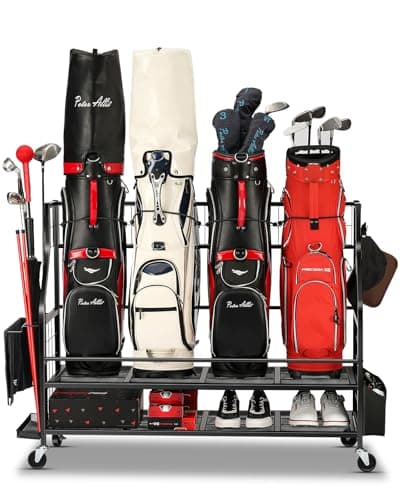
The less obvious cost is the one that decides whether a junior ever plays. In a house with three bags on a garage floor, the bag at the back is unreachable. Getting to it means moving the other two, and a fifteen-year-old who has to move two adult bags to get their own clubs plays less often than one who does not. A rack is not storage in that house, it is access - which is why the four-slot pick on this page is on it at all.
What a rack cannot fix is a bag that went away wet. If the towel is still damp and the rain jacket is balled into a pocket, the bag stays humid on a rack exactly as it does on the floor. The order of operations is empty and dry it first, then put it somewhere it can stay dry, and the rack is the second half of that sentence rather than a substitute for the first.
The one question that decides this gift: freestanding or wall-mounted?
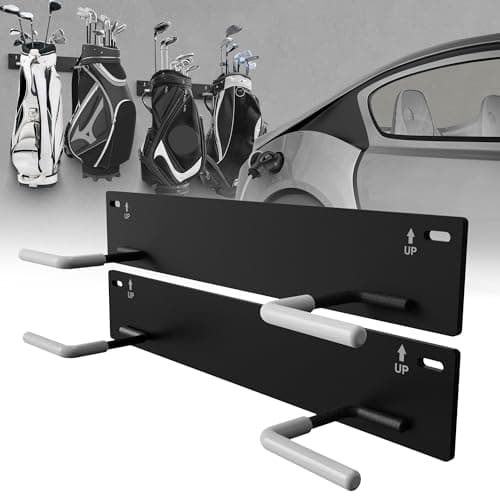
This is the whole ranking criterion on this page, and the answer is almost always freestanding. Not because wall mounts are bad - the cheapest pick here is a wall mount and it is genuinely the best value in the category - but because of who is buying.
A wall mount has to go into studs or masonry. That means a drill, a stud finder, the right anchors for the wall in question, and a permanent, irreversible decision about where in somebody else's garage their clubs will live from now on. None of those are things a gift gets to decide. If the recipient rents, it is worse than inconvenient: a tenant drilling four holes in a garage wall for a golf bag is a conversation with a landlord, and the likely outcome is a boxed rack that never goes up.
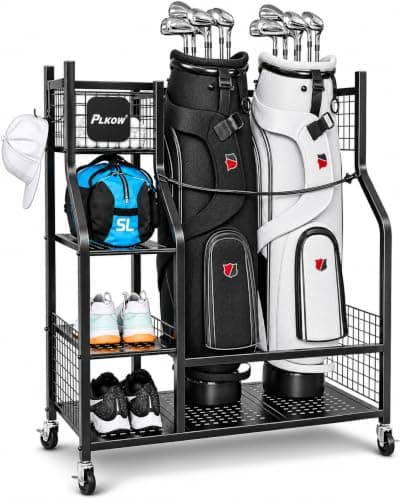
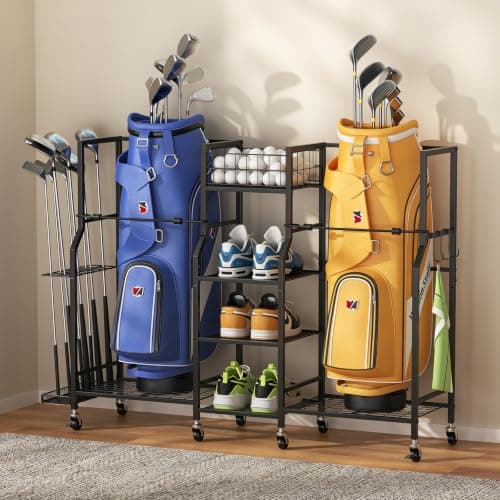
A freestanding rack asks nothing. It arrives, it gets assembled on the floor, and if the first spot is wrong it moves. Every freestanding pick on this page except the wooden one is on wheels, which turns "wrong spot" from a problem into a shove. That is the difference between a present that is in use by the weekend and one that is in use in March, and it is the reason the ranking looks the way it does.
Buy the wall mount in exactly one case: you are buying it for your own garage, or for somebody who has already told you they want one. It is cheap, it uses no floor at all, and in a garage where every square foot is spoken for that argument wins on its own merits.
The only measurement you need
Not the rack. The floor.
You do not need a tape measure in their garage and you do not need to know what they drive. You need to know one thing: is there a free patch of wall, or isn't there?
Yes, there is a clear wall or corner: buy the two-bag rolling rack. It is the top pick for the same reason it is the default - it holds the bag they have and the bag they will eventually buy, and it rolls out of the way on the day they need the floor.
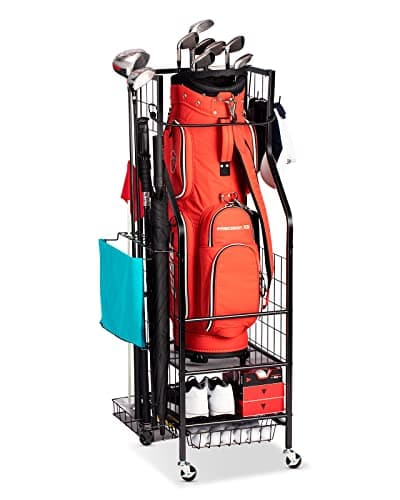
No, the garage is full: buy the single-bag rolling stand. It is the narrowest thing on this page that still stands a bag upright, and it fits in the gap between the car and the wall where nothing else fits. A stand that is too small still gets used; a rack that does not fit goes back.
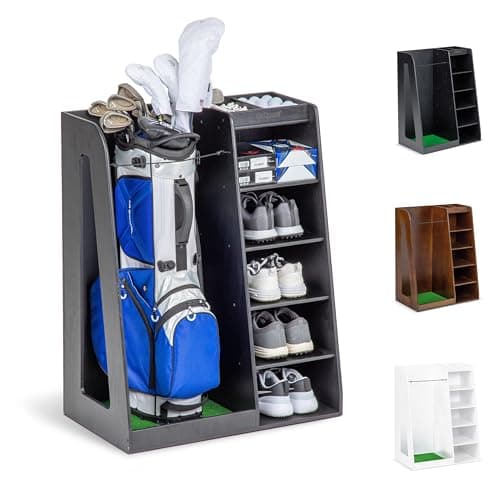
There is no garage - the clubs live in a spare room or a basement: buy the wooden rack. It is the only pick here that looks like furniture instead of shelving, and for the growing number of golfers whose gear shares a room with a practice net or a putting mat, that matters more than capacity.
There are three or more bags: buy the four-slot. This is the only case where capacity is the deciding factor rather than a specification on a listing.
What goes on a rack besides the bag
Worth knowing, because it is the difference between the cheapest pick and the second one. A golfer's garage overflow, roughly in order of how much floor it occupies:
The push cart, which is bulkier folded than people expect and is the single biggest item after the bag itself. Then shoes - usually two pairs, one of them permanently damp. A range bucket or a mesh bag of shag balls. Loose sleeves. A second-hand set that belonged to a parent and will never be used but cannot be thrown away. A tube of alignment sticks. An umbrella. Winter gear in summer and summer gear in winter.
A rack that holds only bags leaves all of that on the floor, which is why the second-ranked pick here is the one with the most shelving rather than the one with the most bag slots. If the honest description of the problem is "the golf stuff" rather than "the golf bag," buy shelves.
One thing that should not go on a garage rack: anything that needs to stay at a stable temperature. A garage is fine for clubs, as long as it is dry - cold on its own does not damage a golf club. It is a worse home for a rangefinder or a GPS watch with a lithium battery, and those belong in the house. How to store golf clubs works through the full ranking of places, including why the car trunk is worse than it looks.
What to look for, in the order it matters
1. Freestanding, unless you own the wall. Covered above. It is the only criterion on this list that can make the gift unusable rather than merely imperfect.
2. Wheels. Every rolling pick here states them, and they are worth more than they sound. A garage is the one room in a house that periodically has to become empty - a bike goes in, furniture comes out, somebody paints something. A rack on wheels gets shoved aside in five seconds. A rack without wheels gets unloaded, carried and reassembled somewhere else, and that is the point at which it stops getting used.
3. Shelving, not bag slots. Nearly everything in this category will stand a bag up; the differences are in what else it takes. Count shelves and look for a ball basket and a shoe level if the problem is clutter rather than one leaning bag.
4. Whether the base lifts the bag off the slab. The point of the exercise. A rack whose base is a flat panel sitting on concrete has moved the damp problem rather than solved it; one that stands the bag on a raised platform or a turf mat has actually fixed it.
5. Bag capacity, last. It is the number every listing leads on, and for the one-golfer household it is the number that matters least. Two slots is the sensible default because golfers accumulate a second bag, not because one bag needs two slots.
The listing trap in this category
Worth a paragraph on its own, because it is the one way this gift arrives wrong.
Several racks in this category are sold in more than one size under titles that are identical or near-identical. Searching the Amazon catalog for the wooden rack on this page returns six listings with effectively the same product name, at two clearly separated price points - the narrow single-bag version and the wider two-bag version - with the difference carried in a selected option rather than in the name. It is the same structural trap as handedness on a beginner set: the page you are looking at and the thing in your cart are not necessarily the same object.
The defense is boring and it works. Before you order, look at the selected option and the stated dimensions, not the title. If a listing gives two widths, the narrow one does not hold two bags no matter what the page is called.
Who this is wrong for
Three cases, all worth checking before you order.
The golfer who keeps everything at the club. Members with a locker frequently store shoes, spare gear and sometimes the bag itself at the course. For them a garage rack is furniture for a problem they do not have, and a better bag or something that lives in the locker is the gift.
The golfer whose clubs live in the car. Plenty of golfers play after work and the bag genuinely never comes inside. A rack in that garage holds nothing for eight months of the year. The honest gift there is the trunk version of this idea, which solves the same mess in the place the mess actually is.
Anyone who needs the present to feel like an occasion. This is a practical object, and the cheaper picks here are unmistakably practical objects. They are excellent as a gift for the golfer who owns everything - because the one thing they genuinely do not own is somewhere to put it all - and underwhelming as the only box under the tree. The fix is the same as it is for every practical gift: put something in it. A dozen balls and a towel on the shelf turns a rack into a display case.
How we picked
Freestanding first, then wheels, then how much of the rest of the kit the rack takes, then price. We did not rank on advertised bag capacity, and we did not rank on published dimensions, for the same reason the trunk organizer page refuses to rank on capacity in liters: the listings in this category are not all measuring the same way, and a league table of numbers that disagree about their own definitions looks more precise than it is.
Every specification on this page is attributed to the product listing, because for generic steel garage racks the listing is the only published source that exists. There are no manufacturer spec sheets for most of these, we have not assembled one, and we are not going to imply otherwise. Every ASIN was resolved through the Amazon product API on 5 November 2026 and confirmed available before it was written here. How we pick sets out the method in full.